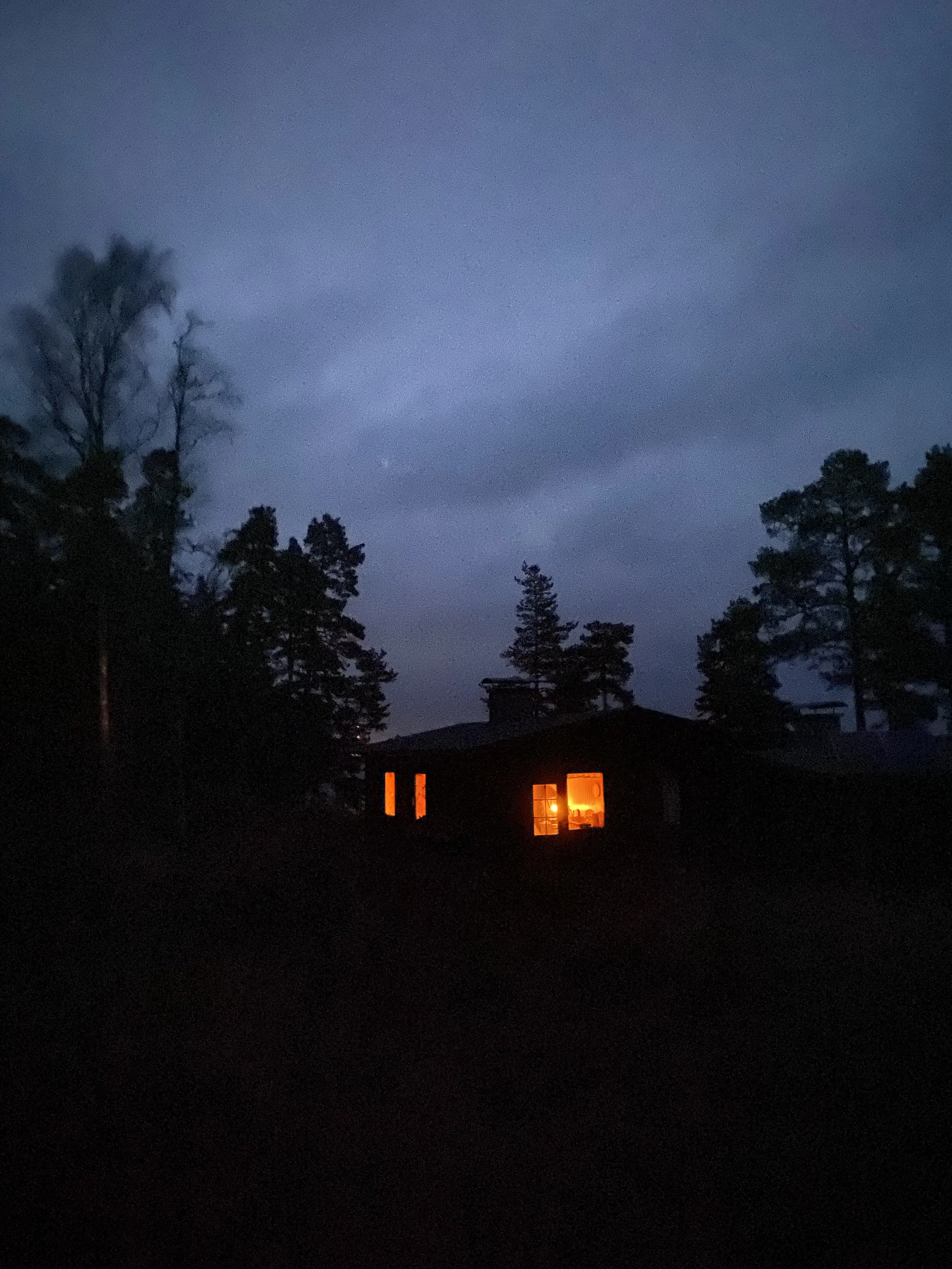
There is a lot of research done on the topic of how reduced daylight affects the circadian rhythm and how it plays a role in seasonal depression so often experienced by people living in Northern countries. And all of that is valid and important, yet still it leaves people with very little to no ways of really reducing the effects it is having on us each year for multiple months. But rather than just accepting it as the whole reality, I got curious about what more could there be to it and what parts of it we could affect in some ways, which led me to research this topic from a slightly different lens. This is not by any means a lens that is fighting against the most often talked about factors, but instead looking at the other ingredients that also play a role.
Viewing darkness through a lens of danger
We humans evolved to be more active during the daytime, making the visual sense our dominant sense for threat detection and spatial orientation. Therefore, darkness poses a threat to our brain’s ability to form a clear sense of the environment around us and our bodily boundary, which leaves us more vulnerable to threats. Therefore, it makes sense why our brain would discourage moving in darkness by alerting us with fear OR…
With depressive symptoms, which could also be seen as the brain’s way of encouraging passivity in the face of a danger that it no longer sees we can overcome.
Decresing sensory ambiguity through gradual adaptation to low lit environments
Darkness is perceived as a threat because the brain’s threat-detection system is primed to interpret this sensory ambiguity and reduced visual input as potential danger. This is a response rooted in evolutionary survival mechanisms in response to reduced sensory input. But there also lies the key for how we can both respect this protective response while also reducing this perceived threat by another factor that is the brain’s ability for sensory re-weighting.
In the face of reduced sensory input from one of our sensory systems or when sensory input from one source becomes noisy or conflicting with the other senses, the brain has the ability for something we call “re-weighting” which essentially means reducing incoming information from once source while increasing that from another while forming our perception of reality.
So instead of increasing artificial lighting in order to fight against darkness and in its associated depressive symptoms, it could be argued that a better approach could be doing the actual opposite. By decreasing high contracts between highly lit indoor spaces and dark outdoor environments we could leverage the brain’s ability to re-weight sensory information. As the brain adapts to lower light conditions with reduced visual accuracy, it increases reliance on proprioceptive and auditory cues, which improves spatial safety perception and reduces sensory ambiguity. This process helps the brain interpret darkness less as a potential threat and more as a familiar, manageable environment which could help reduce depressive symptoms as the perceived threat gets perceived as more manageable.
Here are some practical ways to gradually adapt to low-light environments, which may help the brain re-weight sensory systems toward proprioception and hearing for improved spatial safety:
Start your days in softly lit rooms (e.g., dim lamps or candlelight) to allow your brain to shift attention toward non-visual cues.
Use gradual transitions between lighting levels when moving from bright to dark spaces, so your sensory systems have time to re-weight.
Practice mindful movement in low light to enhance proprioceptive awareness and spatial orientation.
Train your auditory attention by focusing on subtle sounds in low-light environments, which can improve spatial navigation and reduce threat perception.
-Ansku
Would you be interested in exploring why viewing various unpleasant experiences through the lens of danger can help us comprehend the reasons behind pain flare-ups? These episodes often occur not due to "incorrect movements," but rather because our pain threshold is reached when confronted with multiple danger signals?
Sign up to my mailing list below if you are interested in receiving my next article on this topic directly to your inbox!
References:
(2026). Hypervigilance Theory. 10.17605/osf.io/qkpzu.
Hutmacher F. Why Is There So Much More Research on Vision Than on Any Other Sensory Modality? Front Psychol. 2019 Oct 4;10:2246. doi: 10.3389/fpsyg.2019.02246. PMID: 31636589; PMCID: PMC6787282.
Li Y, Hou S, Zhang X and Wang A (2025) Sensory reweighting for postural stability in individuals with low vision and blindness: balance adaptation and muscle co-contraction. Front. Physiol. 16:1684671. doi: 10.3389/fphys.2025.1684671
Mcglashan, Elise & Poudel, Govinda & Jamadar, Sharna & Phillips, Andrew & Cain, Sean. (2021). Afraid of the dark: Light acutely suppresses activity in the human amygdala. PLOS ONE. 16. e0252350. 10.1371/journal.pone.0252350.
Mette Hvass, Kevin Van Den Wymelenberg, Sebastian Boring, Ellen Kathrine Hansen. Intensity and ratios of light affecting perception of space, co-presence and surrounding context, a lab experiment. Building and Environment. Volume 194. 2021. 107680, ISSN 0360-1323, https://doi.org/10.1016/j.buildenv.2021.107680.
Neuberg SL, Kenrick DT, Schaller M. Human threat management systems: self-protection and disease avoidance. Neurosci Biobehav Rev. 2011 Mar;35(4):1042-51. doi: 10.1016/j.neubiorev.2010.08.011. Epub 2010 Sep 15. PMID: 20833199; PMCID: PMC3024471.
Yilmaz Balban M, Cafaro E, Saue-Fletcher L, Washington MJ, Bijanzadeh M, Lee AM, Chang EF, Huberman AD. Human Responses to Visually Evoked Threat. Curr Biol. 2021 Feb 8;31(3):601-612.e3. doi: 10.1016/j.cub.2020.11.035. Epub 2020 Nov 25. PMID: 33242389; PMCID: PMC8407368.