Why “grounding” requires more than just the feet touching the ground?
We often utilize the word “grounding” when we talk about ways to soothe the nervous system, but it is more complex than that. The brain does not simply rely on the soles of the feet touching the floor to feel safe, but instead, it maintains an ongoing internal model of gravity based on ongoing inputs from the visual-, vestibular- and somatosensory systems. Gravity influences all of our physiological systems, but because we lack a dedicated sensory organ for gravity, the brain relies on this multi-sensorial integration to understand body positioning in space which creates our internal model of gravity.
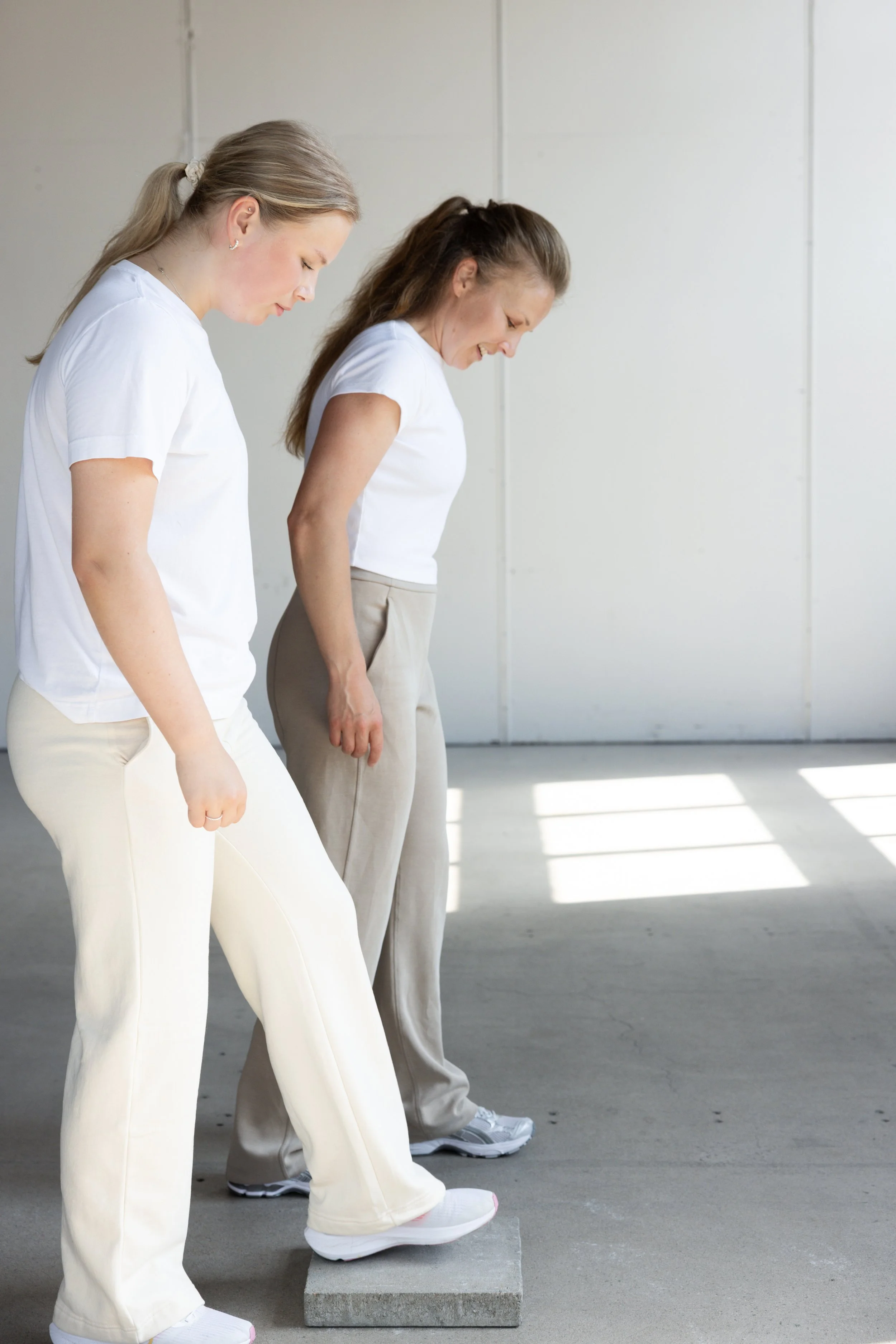
Our internal model of gravity is based upon these three primary systems:
Vestibular system: The inner ear structures that detect head tilt and linear acceleration.
Somatosensory system: It relies on specialized sensory receptors to measure body position and it’s interaction with the environment.
Visual system: Visual cues that provide an external reference for verticality and spatial orientation.
The brain combines these sensory streams to establish a baseline of safety, which we could call “grounding”.
our internal model of gravity provides an anchor for our embodied sense of self
Our physical self is shaped by our internal model of gravity, influencing how we interact with our environment and perceive ourselves. Standing upright and engaging with our surroundings, or struggling to do so, affects our self-image and how we perceive the world around us.
In addition to being the “balance system”, the vestibular system also mediates behavioral functions like posture, gait, and gaze, as well as autonomic functions and higher-order cognitive processes like spatial navigation, learning and memory, and behavioral control. It also plays a crucial role in our sense of embodiment, self-location, and bodily self-awareness.
Changes in our ability to receive and process sensory information not only impact our physical bodies but also influence our entire sense of self. Embodiment is the deep, subconscious experience of living within one's body, closely linked to our senses and movements. It represents a state in which the mind acknowledges its physical presence, forming a unique personal perspective. This connection between mind and body shapes our thoughts and actions, providing a sense of identity, location, and desire.
The link between disrupted sensory integration and chronic stress related symptoms
When the nervous system is overwhelmed, such as in conditions like chronic pain or PTSD, processing and integrating sensorial information often become disrupted. When the brain struggles to integrate sensory perceptions from the body it leaves a person desperately searching for an anchor that seems unreachable. Trauma and chronic stress can overwhelm the nervous system, impairing the ability to feel internal bodily signals and determine the body's position in space. When these sensory pathways are weakened, a person loses connection to their physical grounding and literally loses the "sense" of the ground beneath their feet.
Without clear spatial signals from the vestibular system and positional data from proprioceptive receptors, the brain may struggle to integrate the sensation of ground contact. This confusion might lead the brain to perceive the ground as a threat, causing the body to instinctively tense up against gravity, as if preparing to prevent a fall. This occurs due to alterations in the brain's perception of the body's position in space, which stem from difficulties in integrating vestibular, visual, and proprioceptive signals.
To manage sensory overload, the nervous system recalibrates by adjusting the weight it gives to different types of sensory information. In order to avoid confusion and maintain postural balance, it reduces reliance on the less reliable or "noisy" vestibular and proprioceptive signals while increasing dependence on visual cues. Essentially, the nervous system favors dependable input from one sense over uncertain input from others, continuously adjusting these preferences in order to maintain balance.
Understanding How Diminished Sensory Input Intensifies Bodily Disconnection
By reducing sensory input, one can gain temporary relief from imbalance, but it may create a long-term problematic cycle. When the body and environmental information decreases, the brain is left without the essential data needed to rebuild an accurate internal model or gravity and therefore struggles to accurately map self-location, bodily self-awareness, and the boundaries of the self ultimately worsening bodily disconnection as often seen in chronic stress related conditions.
Initially, these reactions might help reduce sensorial overwhelm, but over time, they impair sensory flow, worsening stress-related symptoms and reducing one’s stress tolerance. In new environments, uncertainty about movement safety prompts the nervous system to a freeze response as a protective measure. Muscles tighten to stabilize against perceived risks, leading to reduced sensory input. While this numbing helps in the short term, it ultimately reduces our ability to adapt to changing environments. As a result, individuals might avoid situations that could worsen their symptoms, creating a cycle that reduces their stress tolerance over time.
In the long term, this sensory confusion can lead to visual overload, postural instability, worsening of PTSD symptoms, and chronic pain due to increased alertness, sensory overload, and a continuous threat response. When the brain struggles to predict gravitational stability, it interprets even small movements as instability or danger, resulting in persistent nervous system arousal and heightened pain perception as a protective mechanism. This altered sensory regulation causes hypersensitivity in the sensory cortex, meaning that ordinary environments, such as crowds, loud noises, or bright lights, can quickly trigger overwhelming sensations and panic.
Additionally, researches in movement sciences and clinical psychology reveal the intricate links between postural threat, anxiety, fear of falling, and balance confidence. When individuals lack an accurate internal model of gravity, their nervous system has difficulty managing arousal and maintaining emotional stability. An unstable physical foundation often leads the autonomic nervous system to activate compensatory muscle bracing to prevent falls. This reaction keeps the body in a heightened state of alertness or causes oscillations between anxiety and feeling overwhelmed. As a result, regulating emotions becomes substantially more challenging, highlighting the deep somatic roots of emotional processing and emphasizing the need to treat the whole person rather than focusing solely on the symptoms presented.
Treatment of symptoms sourcing from inaccurate internal model of gravity
Integrating somatic practices to foster a sense of safety within the nervous system, alongside multisensory integration aimed at refining an accurate internal model of gravity, can significantly aid patients experiencing chronic pain or PTSD symptoms.
Establishing a baseline of safety within the nervous system is the crucial first step to reduce overwhelm which allows the brain to regain more capacity to process new information. Once achieved, the initial focus in movement is the formation of an accurate internal model of gravity. This entails gradual, non-threatening exposure to new sensory stimuli, which helps soothe the nervous system and orient the body in space. Once the brain has established a foundational sense of orientation, the subsequent step involves learning to manage internal pressure to maintain postural stability against gravity. Adequate intra-abdominal and thoracic pressure offers intrinsic postural stability, minimizing reliance on limbs or the neck for support. Instead of resisting gravity, we can begin to leverage it as a stable foundation for movement expression.
This approach not only assists patients in processing overwhelming, unintegrated past experiences but also facilitates the integration and reshaping of new responses and behaviors. The term “re-patterning” in PRI (Postural Restoration Institute) refers to self-directed neuroplasticity. This method is personally meaningful, comprehensible, and emotionally resonant. Altering physical and psychological reactions to experiences involves a neurological process of introducing an intermittent, weak "trigger" while in a positive and safe context. The trigger must be subtle enough to prevent negative emotional responses from signaling a threat to the midbrain. This method resembles somatic therapy sessions, where patients cultivate tolerance for sensations or emotions tied to negative experiences. PRI can be introduced once the patient has built sufficient tolerance to bodily sensations, enabling them to progress toward creating new patterns by optimizing posture-related autonomic physiological behaviors.
If you are interested in this integrational approach to the treatment of chronic stress related symptoms, then check out my coaching package with Somatic practices combined with Postural restoration treatment: https://app.paperbell.com/checkout/packages/142709
-Ansku
References:
Adkin, A. L., & Carpenter, M. G. (2018). New Insights on Emotional Contributions to Human Postural Control. Frontiers in neurology, 9, 789. https://doi.org/10.3389/fneur.2018.00789
Assländer, L., & Peterka, R. J. (2014). Sensory reweighting dynamics in human postural control. Journal of neurophysiology, 111(9), 1852–1864. https://doi.org/10.1152/jn.00669.2013
Blackett, L., Radcliffe, P., Rexhepi-Johansson, T., & Reynolds, N. (2025). "When my mind hurts, my body hurts": Complex PTSD and chronic physical health conditions-A qualitative study exploring the factors contributing to their relationship. The British journal of clinical psychology, 64(4), 1020–1042. https://doi.org/10.1111/bjc.12551
Bouisset, N., Phylactou, P., & Duport, A. (2025). The vestibular system in pain and embodiment: cortical overlap, modulatory potential, and therapeutic perspectives. Frontiers in neuroscience, 19, 1661515. https://doi.org/10.3389/fnins.2025.1661515
Brockdorf, A. N., Simpson, L. E., & DiLillo, D. (2025). Bidirectional associations between PTSD symptoms and pain in daily life among women survivors of sexual assault. Journal of anxiety disorders, 114, 103051. https://doi.org/10.1016/j.janxdis.2025.103051
Cullen, K. E., & Zobeiri, O. A. (2021). Proprioception and the predictive sensing of active self-motion. Current opinion in physiology, 20, 29–38. https://doi.org/10.1016/j.cophys.2020.12.001
Delle Monache, S., Indovina, I., Zago, M., Daprati, E., Lacquaniti, F., & Bosco, G. (2021). Watching the Effects of Gravity. Vestibular Cortex and the Neural Representation of "Visual" Gravity. Frontiers in integrative neuroscience, 15, 793634. https://doi.org/10.3389/fnint.2021.793634
Ferrè, E.S., Bottini, G.,Iannetti, G. , D, Haggard, P. (2013). The balance of feelings: Vestibular modulation of bodily sensations, Cortex, Volume 49, Issue 3, Pages 748-758, ISSN 0010-9452. https://doi.org/10.1016/j.cortex.2012.01.012.
Guzmán-Muñoz, E., Montalva-Valenzuela, F., Garcia-Carrillo, E., Castillo-Paredes, A., López-Gil, J. F., Narrea Vargas, J. J., Yáñez-Sepúlveda, R., & Concha-Cisternas, Y. (2026). Postural Balance and Human Movement: An Integrative Framework for Mechanisms, Assessment, and Functional Implications. Journal of clinical medicine, 15(7), 2588. https://doi.org/10.3390/jcm15072588
Hall, K. J., Van Ooteghem, K., & McIlroy, W. E. (2023). Emotional state as a modulator of autonomic and somatic nervous system activity in postural control: a review. Frontiers in neurology, 14, 1188799. https://doi.org/10.3389/fneur.2023.1188799
Harricharan, S., McKinnon, M. C., & Lanius, R. A. (2021). How Processing of Sensory Information From the Internal and External Worlds Shape the Perception and Engagement With the World in the Aftermath of Trauma: Implications for PTSD. Frontiers in neuroscience, 15, 625490. https://doi.org/10.3389/fnins.2021.625490
Hua, A., Westlake, K. P., Bonnet, C. T., & Wang, J. (2025). Sensorimotor mismatch disrupts motor automaticity and increases anxiety during a goal-directed balance task. Frontiers in human neuroscience, 19, 1632265. https://doi.org/10.3389/fnhum.2025.1632265
Jörges, B., & López-Moliner, J. (2017). Gravity as a Strong Prior: Implications for Perception and Action. Frontiers in human neuroscience, 11, 203. https://doi.org/10.3389/fnhum.2017.00203
Kearney, B. E., & Lanius, R. A. (2022). The brain-body disconnect: A somatic sensory basis for trauma-related disorders. Frontiers in neuroscience, 16, 1015749. https://doi.org/10.3389/fnins.2022.1015749
Kent, L. (2024). Mental gravity: Modelling the embodied self on the physical environment,Journal of Environmental Psychology,Volume 94, 102245, ISSN 0272-4944, https://doi.org/10.1016/j.jenvp.2024.102245.
Kent L. (2023). Mental Gravity: Depression as Spacetime Curvature of the Self, Mind, and Brain. Entropy (Basel, Switzerland), 25(9), 1275. https://doi.org/10.3390/e25091275
Koncz, A., Egri, D., Yildirim, M., Lobko, A., Máté, E., McVige, J. W., & Schwartz, K. (2024). Postural Responses in Trauma-Experienced Individuals. Biomedicines, 12(12), 2766. https://doi.org/10.3390/biomedicines12122766
Lacquaniti, F., Bosco, G., Gravano, S., Indovina, I., La Scaleia, B., Maffei, V., & Zago, M. (2014). Multisensory integration and internal models for sensing gravity effects in primates. BioMed research international, 2014, 615854. https://doi.org/10.1155/2014/615854
Malmström, E. M., Fransson, P. A., Jaxmar Bruinen, T., Facic, S., & Tjernström, F. (2017). Disturbed cervical proprioception affects perception of spatial orientation while in motion. Experimental brain research, 235(9), 2755–2766. https://doi.org/10.1007/s00221-017-4993-5
Marazziti, D., Russomanno, G., Gambini, M., Digiuseppe, F. R., Fazio, E., & Gurrieri, R. (2026). Sensory Deprivation and the Brain: Neurobiological Mechanisms, Psychological Effects, and Clinical Implications. Brain sciences, 16(2), 122. https://doi.org/10.3390/brainsci16020122
McKeown, J., McGeoch, P. (2025). Vestibular nerve stimulation may treat post-traumatic stress disorder, Medical Hypotheses, Volume 199,111650, ISSN 0306-9877,https://doi.org/10.1016/j.mehy.2025.111650.
Michael, GA., Guyot, D., Tarroux, E. , Comte, M. and Salgues, S. (2020) Feeling Oneself Requires Embodiment: Insights From the Relationship Between Own-Body Transformations, Schizotypal Personality Traits, and Spontaneous Bodily Sensations. Front. Psychol. 11:578237. doi: 10.3389/fpsyg.2020.578237
Pasma, J. H., Engelhart, D., Maier, A. B., Schouten, A. C., van der Kooij, H., & Meskers, C. G. (2015). Changes in sensory reweighting of proprioceptive information during standing balance with age and disease. Journal of neurophysiology, 114(6), 3220–3233. https://doi.org/10.1152/jn.00414.2015
Pfeiffer, C., Serino, A., & Blanke, O. (2014). The vestibular system: a spatial reference for bodily self-consciousness. Frontiers in integrative neuroscience, 8, 31. https://doi.org/10.3389/fnint.2014.00031
Rabellino, D., Thome, J., Densmore, M., Théberge, J., McKinnon, M. C., & Lanius, R. A. (2023). The Vestibulocerebellum and the Shattered Self: a Resting-State Functional Connectivity Study in Posttraumatic Stress Disorder and Its Dissociative Subtype. Cerebellum (London, England), 22(6), 1083–1097. https://doi.org/10.1007/s12311-022-01467-4
Rajagopalan, A., Jinu, K. V., Sailesh, K. S., Mishra, S., Reddy, U. K., & Mukkadan, J. K. (2017). Understanding the links between vestibular and limbic systems regulating emotions. Journal of natural science, biology, and medicine, 8(1), 11–15. https://doi.org/10.4103/0976-9668.198350
Santamaría-García, H., Migeot, J., Medel, V., Hazelton, J.L., Teckentrup, V., Romero-Ortuno, R., Piguet, O., Lawor, B., Northoff, G., Ibanez, A. (2025). Allostatic Interoceptive Overload Across Psychiatric and Neurological Conditions, Biological Psychiatry,Volume 97, Issue 1, Pages 28-40, ISSN 0006-3223, https://doi.org/10.1016/j.biopsych.2024.06.024.
Sharp, T., J., Harvey, A., G. (2001). Chronic pain and posttraumatic stress disorder: mutual maintenance? Clinical Psychology Review, Volume 21, Issue 6, Pages 857-877, ISSN 0272-7358, https://doi.org/10.1016/S0272-7358(00)00071-4.
Smith, P. F., & Darlington, C. L. (2013). Personality changes in patients with vestibular dysfunction. Frontiers in human neuroscience, 7, 678. https://doi.org/10.3389/fnhum.2013.00678
Strigo, I. A., Craig, A. D. B., & Simmons, A. N. (2024). Expectation of pain and relief: A dynamical model of the neural basis for pain-trauma co-morbidity. Neuroscience and biobehavioral reviews, 163, 105750. https://doi.org/10.1016/j.neubiorev.2024.105750